A Comparison of Conventional Assessment and Kahoot-Based Assessment Scores on the Topic of Changes in the States of Matter Among Fourth-Grade Madrasah Ibtidaiyah Students
DOI:
https://doi.org/10.51700/mutaaliyah.v6i2.1732Keywords:
formative assessment, Kahoot application, changes in the state of objects, mixed methods, elementary madrasahAbstract
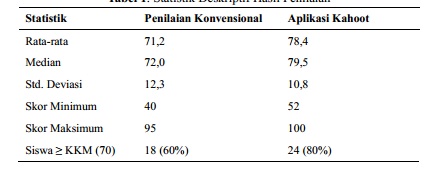
This study compares the assessment results of fourth-grade students of MIU Jabalul Khoir 2 Purwodadi on the material of Changes in the State of Objects between conventional assessment (paper-written test) and assessment based on the Kahoot application. Using a mixed methods approach with a sequential explanatory design, the study involved 30 fourth-grade students as research subjects. Quantitative data were collected through test scores of both instruments, while qualitative data were obtained from interviews and observations. Data integration was carried out through triangulation at the interpretation stage, where qualitative findings were used to explain the differences in scores between the two methods. The analysis results showed a significant difference in average scores, with an average Kahoot score of 78.4 compared to the conventional assessment of 71.2. The paired t-test produced a sig. 0.032 (p < 0.05). Qualitative findings revealed that motivational factors, test anxiety, and interface conditions influenced differences in student performance. This study recommends the integration of Kahoot as a formative assessment instrument in Islamic elementary schools, with a note on the need to adapt to the limitations of technological infrastructure.
Downloads
References
Andayani, T., & Madani, F. (2023). Peran Penilaian Pembelajaran Dalam Meningkatkan Prestasi Siswa di Pendidikan Dasar. Jurnal Educatio, 9(2), 924–930. https://doi.org/10.31949/educatio.v9i2.4402
Arzaq, M. Y. (2024). Inovasi Pembelajaran SD/MI Berbasis Kurikulum Merdeka di Era Digital (1st ed.). PT NAsya Expanding management.
Azizah, E. (2023). Pengembangan Asesmen Berbasis Hots Menggunakan Aplikasi Kahoot Pada Mata Pelajaran Ipas Kelas Iv Sekolah Dasar. repository.unja.ac.id. https://repository.unja.ac.id/45950/
Bloom, B. S. (1956). Taxonomy of Educational Objectives: The Classification of Educational Goals (vol. 1). D. McKay.
Creswell, J. W., & Creswell, J. D. (2023). Research Design: Qualitative, Quantitative, and Mixed Methods Approaches. SAGE. https://books.google.co.id/books?id=b9tFzwEACAAJ
Devi Syukri Azhari, Zihnil Afif, Martin Kustati, N. S. (2023). Penelitian Mixed Method Research Untuk Disertasi. INNOVATIVE: Journal Of Social Science Research, 3(2), 8010–8025. https://j-innovative.org/index.php/Innovative/article/view/1339/979
Dewi, F. (2025). Pengembangan Media Pembelajaran Kahoot Pada Pembelajaran Bahasa Indonesia Kelas V Sd/Mi. repository.radenintan.ac.id. https://repository.radenintan.ac.id/37976/
Dudin, K. I. (2025). Analisis Kesulitan Siswa Dalam Menyelesaikan Soal Literasi Sains Di Mi Negeri 3 Purbalingga. https://repository.uinsaizu.ac.id/id/eprint/34693
Edward L. Deci, R. M. R. (1985). Intrinsic Motivation and Self-Determination in Human Behavior (1st ed.). Springer New York, NY. https://doi.org/https://doi.org/10.1007/978-1-4899-2271-7
Hartika, R. (2025). Aplikasi Kahoot Sebagai Media Pembelajaran Bahasa Arab Untuk Meningkatkan Motivasi Belajar Peserta Didik Di SD Islam Terpadu Insan Gemilang Sigi. repository.uindatokarama.ac.id. https://repository.uindatokarama.ac.id/id/eprint/4657/
Jazilatun Nawali, Indah Aminatuz Zuhriyah, Samsul Susilawati, A. Z. N. Y. (2024). Implementasi Penilaian Autentik Di Sdi Surya Buana Malang Untuk Meningkatkan Kualitas Pembelajaran. Pendas : Jurnal Ilmiah Pendidikan Dasar, 09(04), 2548–6950. https://doi.org/https://doi.org/10.23969/jp.v9i04.20886
Ni Nyoman Gita Suariantini, Basilius Redan Werang, I. G. A. (2023). Instrumen Asesmen Numerasi Online Menggunakan Aplikasi Kahoot Pada Mata Pelajaran Matematika Kelas IV Sekolah Dasar. Innovative: Journal Of Social Science Research, 3(2), 5712–5824. http://j-innovative.org/index.php/Innovative/article/view/930
Pane, I. (2021). Desain penelitian mixed method. Yayasan Penerbit Muhammad Zaini.
Prof. Dr. Ibnu Hadjar, M. E. (2022). Teori Klasik Dan Modern dalam Pengembangan Tes. CV. Eureka Media Aksara.
Rasyidin, M. U. (2022). Penerapan Teknik Relaksasi Untuk Menangani Kecemasan Menghadapi Ujian Pada Siswa. Jurnal BK Unesa, 12(2), 865–877. https://ejournal.unesa.ac.id/index.php/jurnal-bk-unesa/article/view/45875
Shabiroh, S. A. U. (2023). Komparasi Penggunaan Media Pembelajaran Quizizz Dan Media Pembelajaran Kahoot Terhadap Hasil Belajar Sejarah Siswa Kelas Xii Ipa Sma Negeri 1 Balongpanggang. Avatara: Jurnal Pendidikan Sejarah, 13(2), 0–7. https://ejournal.unesa.ac.id/index.php/avatara/article/view/51348
Stiggins, R. J. (2001). Student-Involved Classroom Assessment (3rd ed.). Merrill Prentice Hall.
Subhaktiyasa, P. G. (2024). Evaluasi Validitas dan Reliabilitas Instrumen Penelitian Kuantitatif : Sebuah Studi Pustaka. Journal of Education Research, 5(4), 5599–5609. https://www.researchgate.net/profile/Putu-Gede-Subhaktiyasa/publication/386012499_Evaluasi_Validitas_dan_Reliabilitas_Instrumen_Penelitian_Kuantitatif_Sebuah_Studi_Pustaka/links/673f3f0bb2d7de5adc4a0ed2/Evaluasi-Validitas-dan-Reliabilitas-Instrumen-Penelitian-Kuantitatif-Sebuah-Studi-Pustaka.pdf
Sugiyono, P. D. (2019). Metode penelitian pendidikan : (pendekatan kuantitatif, kualitatif dan R & D). Alfabeta Bandung.
Titin Sunaryati, Tazkia Aisha Laelly, Utari Febriyanti, Noviyanti, F. A. (2024). Analisis Komprehensif Terhadap Jenis-Jenis Evaluasi Pembelajaran Sekolah Dasar: Tinjauan Literatur. INNOVATIVE: Journal Of Social Science Research, 4(04), 32435–32444. https://doi.org/https://doi.org/10.31004/innovative.v4i4.13463
Downloads
Published
How to Cite
Issue
Section
License
Copyright (c) 2026 Puspadenty Arningtyas Anggraeny

This work is licensed under a Creative Commons Attribution-ShareAlike 4.0 International License.
License Terms
Karya dalam Jurnal AL-Muta`aliyah dilisensikan di bawah Lisensi Internasional Creative Commons Attribution-ShareAlike 4.0 (CC BY-SA 4.0) dengan ketentuan sebagai berikut:
1) Pengguna bebas untuk menyalin dan mendistribusikan ulang materi dalam media atau format apa pun, me-remix, memodifikasi, dan mengembangkan materi berdasarkan ketentuan ini.
2) Pengguna harus memberikan penghargaan yang sesuai, menyediakan tautan ke lisensi, dan menunjukkan jika ada perubahan yang dilakukan.
3) Pengguna dapat melakukannya dengan cara yang wajar, tetapi tidak dengan cara yang menunjukkan bahwa pemberi lisensi mendukung pengguna atau penggunaan mereka.
 This work is licensed under a